
TL;DR
- AI terms are not interchangeable. Machine learning, generative AI, LLMs, agents, agentic AI and neuro-symbolic AI describe different approaches or capabilities, while AGI and superintelligence describe potential levels of intelligence.
- AI is moving towards greater autonomy. The progression from predicting and generating to reasoning and acting gives AI greater responsibility within the enterprise.
- More capable AI needs more than data. It needs shared meaning, business context, knowledge, rules and clear governance to operate effectively and safely.
- Preparing for future AI helps today. Stronger data, knowledge architecture, governance, observability and human oversight make current AI more useful, trustworthy and controllable.
What the terms mean for enterprise
AI terminology is getting crowded. Artificial intelligence, machine learning, generative AI, large language models, agents, agentic AI, neuro-symbolic AI, AGI and superintelligence are increasingly used in the same conversations, often with very different meanings depending on who is speaking.
For business leaders, I don’t think the most important question is which term wins. What matters is understanding what the technology can actually do, how much responsibility we are giving it, what information it relies on and how we know we can trust what comes back.
That becomes more important as we move from systems that predict an outcome, to systems that generate content, reason across information and increasingly take action on our behalf. Before looking at what this means for the enterprise, it is worth establishing some common language.
A practical view of the AI landscape
There is no single industry standard covering every variation of AI. Some terms have well-established definitions from organisations such as the OECD and NIST, while areas such as AGI, superintelligence and neuro-symbolic AI are still better represented through research frameworks. The definitions below are therefore deliberately practical rather than academic.
The definitions below are therefore deliberately practical rather than academic.
What is Artificial Intelligence?
Artificial Intelligence (AI) is a machine-based system that uses inputs to generate outputs such as predictions, content, recommendations or decisions that can influence physical or virtual environments.
This is adapted from the OECD definition of an AI system, which also recognises that AI systems can operate with different levels of autonomy and may adapt after deployment.
Read more: OECD — Updated Definition of an AI System
What is Machine Learning?
Machine learning, or ML, is a branch of AI where systems identify patterns from data and use those patterns to improve predictions or decisions rather than relying entirely on explicitly programmed rules.
It is the foundation behind many AI capabilities organisations have already been using for years, from fraud detection and forecasting to recommendations and customer segmentation.
Read more: NIST — Machine Learning
What is Generative AI?
Generative AI describes models that learn characteristics and patterns from existing data and use them to create new content such as text, images, software code, video or audio.
NIST describes generative AI as a class of models that emulate the structure and characteristics of input data to generate derived synthetic content.
Read more: NIST — Generative Artificial Intelligence
What are Large Language Models?
Large language models, or LLMs, are language models trained on very large amounts of data that learn statistical patterns and relationships within language. They can then use those patterns to generate, summarise, translate and interpret natural-language content.
Google Cloud describes an LLM as a statistical language model trained on a massive amount of data that can generate and translate text and perform other natural-language-processing tasks. Google also notes that modern LLMs are generally based on deep-learning architectures such as Transformers.
Read more: Google Cloud — Large Language Models
What are AI Agents?
An AI agent is a software system that uses AI to pursue a defined objective, determine the steps needed and carry out tasks using available tools or applications with some degree of autonomy.
This is adapted from IBM’s description of AI agents as systems that autonomously perform tasks by designing workflows and using available tools. IBM also explains that their behaviour is shaped by human-defined goals and rules, including which tools they can use.
Read more: IBM — What Are AI Agents?
What is Agentic AI?
Agentic AI moves beyond simply producing an answer. It describes systems that can pursue objectives, interact with their environment and take actions with some level of autonomy, often using tools, applications or other systems along the way.
The OECD’s 2026 work on agentic AI found that objectives, actions or outputs, and autonomy are among the most common characteristics appearing across definitions of AI agents and agentic systems.
What is Neuro-Symbolic AI?
Neuro-symbolic AI combines the pattern-recognition capabilities of neural or statistical AI with explicit knowledge, logic and reasoning. The idea is important for enterprise AI because businesses do not operate purely on statistical relationships. They also depend on rules, definitions, policies and known relationships that need to be represented explicitly.
IBM Research describes neuro-symbolic AI as combining statistical AI and machine learning with symbolic knowledge and reasoning.
Read more: IBM Research — Neuro-Symbolic AI
What is Artificial General Intelligence?
Artificial General Intelligence, or AGI, generally refers to AI capable of performing effectively across a broad range of intellectual tasks rather than being constrained to a narrow domain.
There is no universally accepted definition or test for AGI. Google DeepMind’s Levels of AGI framework looks at both depth of performance and breadth of generality, while also considering autonomy and risk as AI capabilities increase.
Read more: Google DeepMind — Levels of AGI.
What is Artificial Superintelligence?
Artificial Superintelligence, or ASI, describes a hypothetical level of general intelligence that substantially exceeds human cognitive capability across a broad range of areas.
Google DeepMind’s 2026 From AGI to ASI paper describes artificial general superintelligence as a system that could be more intelligent and cognitively capable than large organisations of humans. It is still a theoretical concept, and the authors are clear that there is considerable uncertainty around how or whether that progression will occur.
Read more: Google DeepMind — From AGI to ASI
These are not simply generations of the same technology
One of the reasons the terminology becomes confusing is that these concepts are related, but they are not interchangeable.
- Machine learning is an approach within AI.
- Large language models can enable generative AI capabilities.
- Generative AI can provide reasoning and language capabilities within agents.
- Neuro-symbolic architectures bring learned patterns together with explicit knowledge and rules.
- AGI and superintelligence describe potential levels of capability rather than a particular technology.
For the enterprise, I think there is a more useful way to look at the progression. It is about what we increasingly ask machines to do:
Predict → Generate → Reason → Act → Generalise → Potentially Surpass
Alongside it sits a progression that gets much less attention:
Data → Meaning → Context → Knowledge → Decisions → Autonomy
The second may ultimately matter more to the enterprise than the first.

From prediction to generation
Predictive AI is not new. Organisations have been using machine learning for years to identify patterns, classify information, detect anomalies and predict outcomes.
Take a bank trying to identify customers who are likely to leave. A predictive model might analyse transaction history, product usage, service interactions and customer behaviour and conclude that a customer has an 82% probability of leaving.
That can be extremely valuable, but the result is still relatively narrow. The model is solving a specific problem using the information it has been given.
Generative AI changes the interaction. Instead of simply predicting that the customer may leave, the system could analyse the information available, summarise the relationship, identify possible reasons for the behaviour and draft a recommended retention message.
This introduces a different enterprise problem. The system is no longer just analysing data; it is interpreting meaning. Ask a model what constitutes a high-value customer and the answer depends on how your organisation defines customer, household, profitability, revenue, risk, product ownership and lifetime value. Those definitions may vary between systems or business areas.
That is why AI readiness is not simply about having more data. It is also about creating shared meaning around the data the AI is expected to use.
For Ortecha, this is where data readiness, semantic models, ontologies, knowledge graphs and Semantic Data Products become increasingly important. They allow the enterprise to explicitly describe what things mean and how they relate, rather than expecting the model to infer everything for itself.
From answers to actions
Agentic AI takes another important step because the technology moves from producing information to participating in the business process. Using the same banking example, an agent might identify the at-risk customer, analyse the relationship, determine which approved offer is available, generate the communication, update the CRM and trigger the next step in the retention process.
At that point, the risk profile changes. The organisation needs to know which systems the agent can access, what data it can see, which actions it is authorised to take and what requires human approval. It also needs to understand what happens when an AI recommendation conflicts with a business rule, policy or another system.
Most importantly, the organisation needs to be able to reconstruct what happened. This is why governance around agents cannot live only in policies or approval committees. As AI becomes more autonomous, governance needs to become increasingly operational and, in many cases, machine-readable.
Ortecha’s role here spans AI and agent inventories, intake and risk classification, enterprise and data architecture, governance, human oversight, decision rights, observability, traceability and the knowledge structures agents need to operate safely.
Why neuro-symbolic AI matters
Generative AI is extremely good at working with ambiguity and patterns. Enterprises, however, also rely on things that should not be ambiguous. A customer owns an account. The account belongs to a legal entity. A regulation applies to that legal entity. A policy implements the regulation, and a control implements the policy.
These relationships matter because they determine what an organisation is permitted to do. Imagine asking an AI whether an agent can use a particular customer’s information for a specific purpose in a given jurisdiction. A language model can interpret the question and analyse documents, but a knowledge graph can explicitly represent the relationships between the customer, data, jurisdiction, regulation, policy, system, process and AI capability.
Symbolic rules can then represent what is permitted. That combination is what makes neuro-symbolic AI particularly interesting for enterprise use. It connects the flexibility of generative AI with explicit enterprise knowledge and reasoning.
It also aligns closely with Ortecha’s work in Knowledge Architecture, Semantic Data Products, Design Observability and Automated Data Management. Policies, standards, definitions and management requirements become structured knowledge that can be used by both people and machines.
What changes if AI becomes general?
AGI is still an uncertain concept, but thinking about it exposes a very real enterprise problem. Today, we effectively have collections of specialised AI capabilities. One system reviews contracts, another writes software, another predicts fraud, another supports HR and another helps with customer service.
A generally capable system would need to operate across those boundaries. For that to work effectively inside an enterprise, it would need to understand far more than individual datasets. It would need to understand what information means, where the authoritative source is, how business concepts relate, which policies apply, how processes work, who owns decisions and what the organisation has done previously.
That starts to look less like a traditional data platform and more like enterprise memory. Enterprise memory is the governed representation of the organisation’s data, meaning, relationships, processes, policies, systems, decisions and history. The idea is not to build one enormous database. It is to make enterprise knowledge accessible and understandable to both people and machines. This is where data management, semantic architecture, enterprise architecture, knowledge graphs, governance and AI enablement start to converge.
And what if intelligence goes beyond us?
Superintelligence is obviously the most speculative part of the discussion, but it raises an important issue about governance. We already have systems that demonstrate superhuman performance in narrow areas. A chess engine can outperform every human chess player, but nobody would describe that as general superintelligence.
The difference with ASI is breadth. Imagine asking a future system to redesign a global supply chain to maximise profitability and resilience over the next ten years. It may need to reason across economics, logistics, geopolitics, regulation, climate, supplier behaviour, technology and consumer demand at a scale no individual person could reproduce.
At that point, simply putting a human at the end of the process and calling it human-in-the-loop may not provide meaningful oversight. The challenge becomes much more fundamental: how do we retain control, provide evidence, understand decisions and maintain meaningful human authority when the system may be more capable than the people overseeing it?
No consultancy can credibly claim to implement enterprise superintelligence today. What organisations can do is prepare for progressively more capable and autonomous AI by building the controls, knowledge, architecture and evidence needed to govern it.
The common thread isn’t the model. It’s the enterprise.
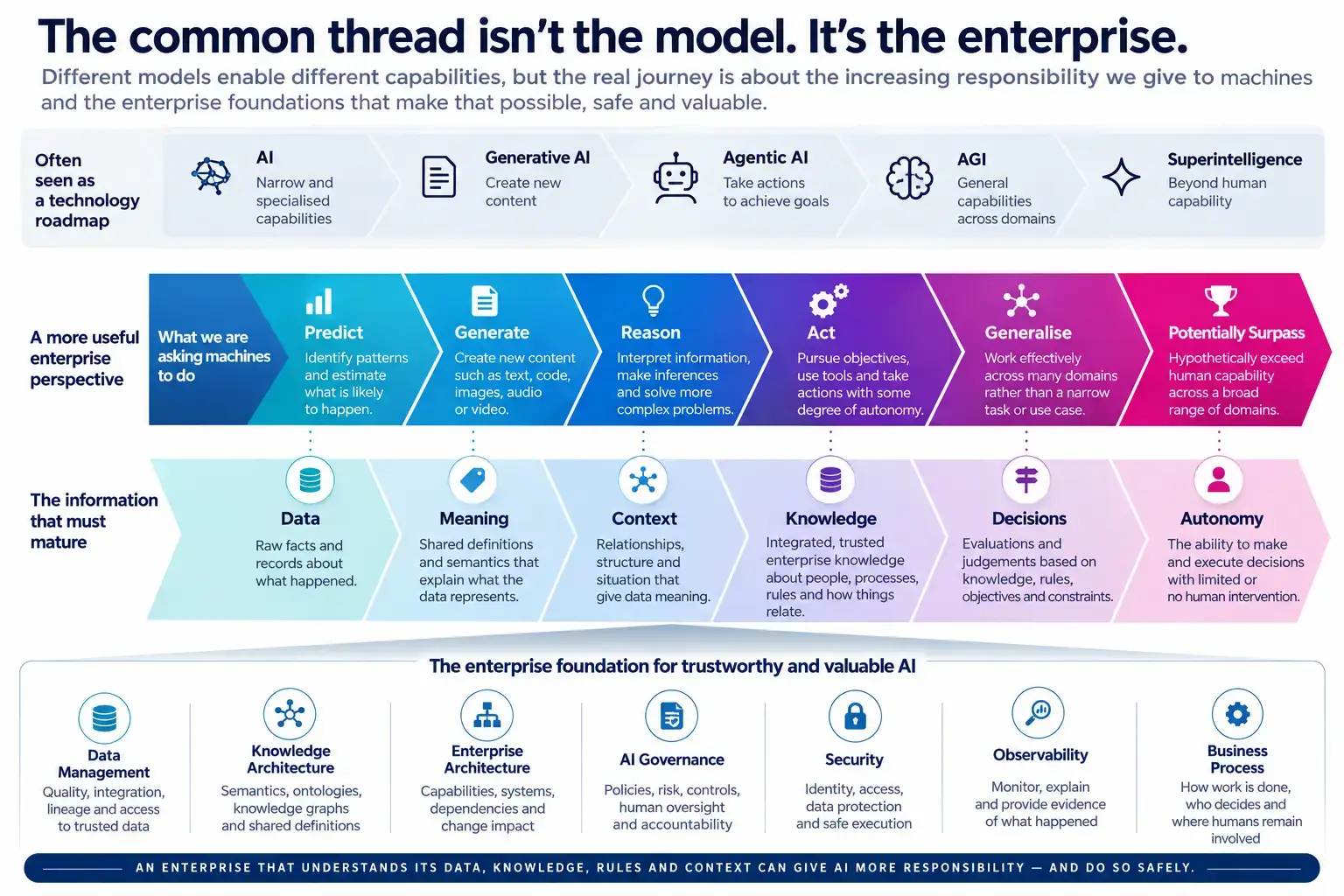
It is tempting to see the market as a technology roadmap, but I think that oversimplifies what is happening. A more useful enterprise perspective considers both the responsibility we give machines and the information foundation beneath it. The three views look like this:
It can expose duplicated controls, weak data ownership, manual reporting processes and disconnected assurance activity. Addressing those weaknesses can improve decision-making, reduce operational risk and give management a clearer picture of how the organisation is actually performing.
AI → Generative AI → Agentic AI → AGI → Superintelligence
Predict → Generate → Reason → Act → Generalise → Potentially Surpass
Data → Meaning → Context → Knowledge → Decisions → Autonomy
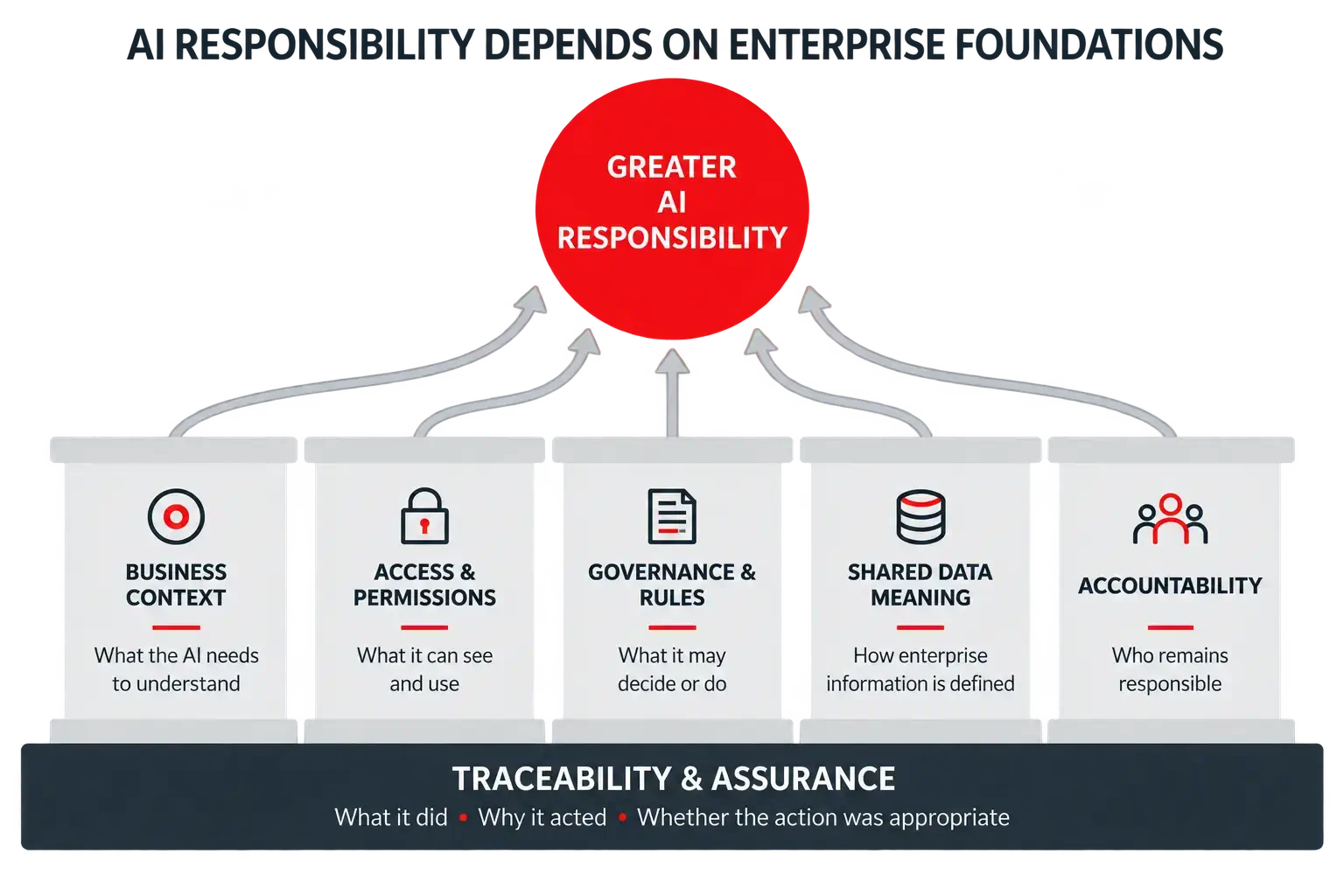
As we give AI greater responsibility, we also need to strengthen the enterprise foundations it depends on. An AI system acting on our behalf needs to understand the business context, work within clearly defined access permissions and follow the rules that govern our decisions. That depends on shared definitions of what our data means and clear accountability for how it is used. As our reliance on these systems grows, we need to be able to trace what they did, understand why and establish whether their actions were appropriate.
This is why AI cannot be treated as an isolated technology initiative. Data Management, AI Governance, Enterprise Architecture, Knowledge Management, Cybersecurity, Privacy, Technology Governance and Business Process increasingly need to operate as connected disciplines.
From data architecture to knowledge architecture
This is why AI cannot be treated as an isolated technology initiative. Data Management, AI Governance, Enterprise Architecture, Knowledge Management, Cybersecurity, Privacy, Technology Governance and Business Process increasingly need to operate as connected disciplines.
Together, these capabilities form a trusted enterprise knowledge foundation. That foundation becomes more important as AI capability increases, not less.

Preparing for tomorrow improves AI today
It is easy to dismiss AGI and superintelligence as future problems, but most of the capabilities needed to prepare for more advanced AI also improve the AI organisations are deploying now.
These foundations improve the AI we are using today by giving models, copilots and agents more reliable data and a clearer understanding of the business. A governed semantic layer and knowledge graphs provide that context, while an inventory of AI systems and agents helps the organisation keep track of what is being deployed, who owns it and where responsibilities overlap. Expressing policies in a form machines can make those rules easier to apply within business processes. Lineage and observability allow us to trace how a result was produced, with human oversight ensuring that decisions requiring human judgement remain with people.

Enterprise memory means future AI systems do not have to continually rediscover what the organisation already knows. That leads to a fairly simple conclusion: the more intelligent the AI becomes, the more important the enterprise foundation becomes.
The question is not when. It is whether we are ready.
There will continue to be debate about when, or whether, AGI and artificial superintelligence arrive. Enterprises do not need to resolve that debate today.
The shift from prediction to generation and increasingly to autonomous action is already underway. Each step places greater demands on the quality of the data, knowledge, governance and architecture surrounding the AI.
The practical question for business leaders is therefore much closer to home: as AI becomes more capable, are we comfortable giving it access to our data, our knowledge and ultimately our decisions?
At Ortecha, this is where we see Data, AI and Technology coming together. The objective is not simply to deploy more AI. It is to create the enterprise foundations that allow increasingly capable AI to be useful, trustworthy and controllable while keeping people at the centre of how it operates. Whatever name we eventually give the next generation of intelligence, the challenge will remain fundamentally human.
Sources and further reading
OECD, Explanatory memorandum on the updated OECD definition of an AI system, 2024.
NIST, Generative artificial intelligence terminology.
Google Cloud, Large language models.
Google Cloud, Generative AI glossary — Large language model.
OECD, The agentic AI landscape and its conceptual foundations, 2026.
IBM Research, Neuro-symbolic AI.
Google DeepMind, Levels of AGI for Operationalizing Progress on the Path to AGI, 2024.
Google DeepMind, From AGI to ASI, 2026.
Let's do a quick recap
What is the difference between generative AI and agentic AI?
Generative AI primarily creates content or responses based on patterns learned from data. Agentic AI goes further by pursuing objectives and taking actions with some degree of autonomy. For enterprises, that shift from generating to acting introduces new questions around access, permissions, accountability and oversight.
What is the difference between an AI agent and agentic AI?
An AI agent is a system that uses AI to pursue an objective and carry out tasks, while agentic AI describes the broader capability or behaviour that enables AI systems to pursue goals and act with autonomy. Put simply, an agent is the system doing the work; agentic describes how it behaves.
What is the difference between agentic AI and AGI?
Agentic AI describes systems that can pursue objectives and take actions with some autonomy, but typically within defined environments or purposes. AGI describes a potential level of intelligence capable of performing effectively across a much broader range of intellectual tasks. An AI system can therefore be agentic without being generally intelligent.
Why does enterprise data become more important as AI becomes more autonomous?
As AI takes on greater responsibility, it needs to understand not only the data it can access, but what that data means, how concepts relate, which sources are authoritative and which rules apply. Greater autonomy increases the importance of trusted data, enterprise context, knowledge and governance.
Does more autonomous AI mean less human involvement?
Not necessarily. Greater autonomy changes where human involvement is needed. Rather than reviewing every AI output, organisations need to define which actions can be delegated, where approval is required and where people retain decision-making authority. Effective human oversight becomes increasingly important as AI takes on greater responsibility.
How can enterprises prepare for more advanced AI?
Enterprises do not need to predict when or whether AGI or superintelligence will arrive. Strengthening data management, semantic and knowledge architecture, AI governance, observability and human oversight improves the AI being deployed today while creating stronger foundations for increasingly capable and autonomous systems.

Stephen Gatchell
Partner, Head of AI Strategy at Ortecha
- Published on
Jump to a section
- What the terms mean for enterprise
- A practical view of the AI landscape
- These are not simply generations of the same technology
- From prediction to generation
- From answers to actions
- Why neuro-symbolic AI matters
- What changes if AI becomes general?
- And what if intelligence goes beyond us?
- The common thread isn’t the model. It’s the enterprise.
- From data architecture to knowledge architecture
- Preparing for tomorrow improves AI today
- Are we ready?
